
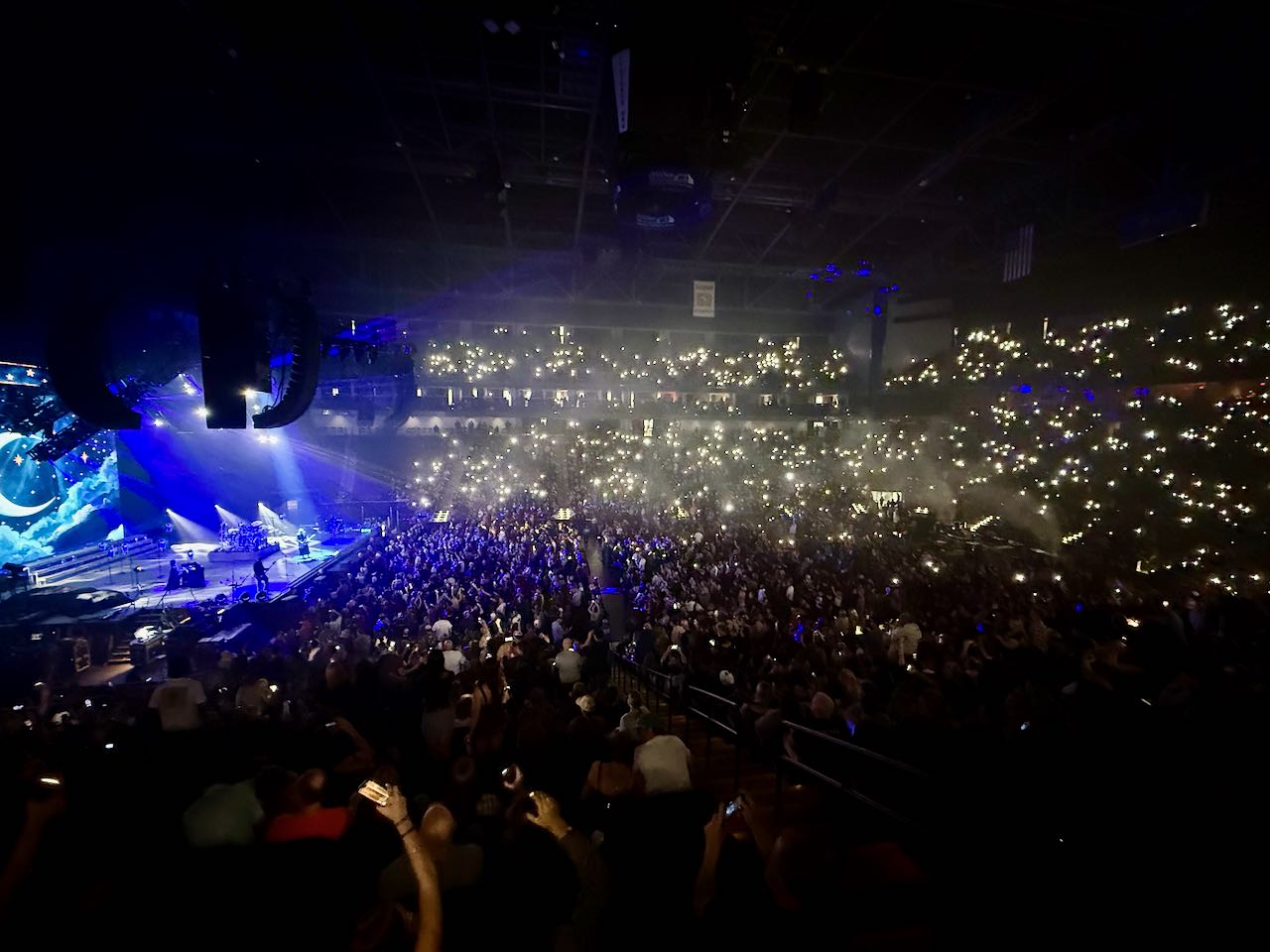
My wife and I celebrated our 14th anniversary last night with dinner and the Smashing Pumpkins at VyStar Veterans Memorial Arena in Jacksonville. We’ve seen a lot of live music together — Paul McCartney twice, The Who, Elton John, Pearl Jam, Guns N’ Roses, Nine Inch Nails. The list goes on. Last night belongs with the best of them.
I didn’t expect that going in. I expected a good show. What I got was something closer to a reminder — the kind that only comes from watching people operate at the highest level of their craft in real time.
They started at 8pm on the dot. No fashionable lateness, no warm-up act running long. The show began when it was supposed to begin because the people who made it have enough respect for their audience to treat the ticket as a contract. Nearly three hours later, they closed with a ten-minute instrumental — no vocals, no singalong, no crowd-pleasing finale. Just the band playing at the edge of what they’re capable of, with Jimmy Chamberlin delivering a John Bonham-scale drum solo that left the room stunned and then roaring.
That’s a choice. You don’t end a show that way unless you trust your audience enough to ask something of them — to sit with something difficult and unfamiliar rather than send them home with a hit they already know by heart. Most acts wouldn’t risk it. The Smashing Pumpkins have spent 35 years not caring about that risk, and it shows in every decision they make on stage.
The production matched the ambition without overwhelming it. Projections displayed visuals drawn from the album’s artwork and lyrics — present in the way good design is present: serving the music rather than competing with it. Hanging lanterns framed the stage with an intimacy that shouldn’t have been possible in an arena. A digital clock was visible on stage throughout the evening — hours, minutes, seconds — keeping time in public, where the audience could see it. They started when they said they would. They played what they came to play. A promise made visible.
At intermission the stage transformed. What returned in the second set suggested the interior of a cathedral — draped curtains taking the shape of a chapel, the entire environment shifted from the first set’s darkness into something architectural and almost sacred. The change in the room was physical. You felt it before you processed it.
The wardrobe was part of the same visual language. Corgan performed the first set in black — a long architectural silhouette, deliberate and slightly severe. The second set he returned in white. A visual arc across the evening, designed by his wife Chloé Mendel Corgan, a couture designer who has been creating his stage wardrobe since 2011 and who describes her objective simply: something timeless that matched the tone of the music. When the person making the clothes understands the music from the inside, it shows. Nothing about what you saw on that stage was accidental. All of it was intentional.
What struck me most wasn’t any single moment. It was the philosophy visible in the whole evening. Every member of the band had a voice. Not just Billy Corgan — every musician on that stage was given space to be heard, space to contribute something the song couldn’t exist without. The setlist pulled deep from Mellon Collie and the Infinite Sadness and then opened into newer work and classic songs in the second half. A show designed for people who love the music, not people who want to hear the two songs they know from the radio.
They were there to give the audience value. Not to collect a check. Not to fulfill an obligation. To give something real to the people who showed up.
I left satisfied in the way you only leave satisfied when you’ve been in the presence of something operating at its fullest capacity. And then, the way it always works when you witness craft at that level, I felt the pull toward my own work — not to imitate what they do, but to ask whether I’m going as deep as I could go.
I’ve been making documentary films for twenty years. I know how to make a film that works. What the Pumpkins reminded me last night is that there’s a difference between a film that works and a film that reaches into the emotional depths of its subject and brings something back that the audience carries with them. That’s the territory I want to explore. Not broader — deeper. Not more accessible — more true.
The films I’m most proud of are the ones where something happened on camera that I didn’t plan for and didn’t engineer. A look. A pause before an answer. A moment where the subject forgot the camera was there and said the thing they actually meant. Those moments don’t come from a tight script or a controlled environment. They come from trust — the trust a subject extends to a filmmaker who has done enough work before the interview to deserve it.
Jimmy Chamberlin didn’t earn that drum solo last night. He earned it over 35 years. The audience felt that. That’s the difference between technique and craft — technique can be learned in a year, but craft is what accumulates when you keep going deeper into the same thing long after most people would have moved on.
The Lilly film inspired me — not because of the budget or the media buy or the Emmy placement, but because someone in that creative chain cared enough about the woman watching at home to make a film that pulled her in rather than hit her over the head with a message. That 67-year-old woman isn’t a target demographic. She’s someone’s aunt. Someone’s mother. Someone’s sister. The struggle with weight is real and raw for a lot of people — and most of them have never seen it honored on screen before. When the film found them, they felt it. Because it was specific enough to be true and true enough to be universal.
Last night did the same thing. Not with a story about a woman and sixty years of private struggle — with music, and light, and a clock on stage counting every second of a promise being kept.
I know where I want to go. The willingness has always been there. What I’m building now — the way I work, the clients I choose, the engagements I take on — is designed to protect the conditions that make the deepest work possible. Budget constraints, time pressure, deliverables shaped by people whose relationship to the creative work begins and ends with the check — those are the variables that have compromised more films than I care to admit. They have never served the end product. Not once.
The Pumpkins play the ten-minute instrumental because nobody in that room has the authority to cut it. Craft operating on its own terms.
That’s where I’m going.