
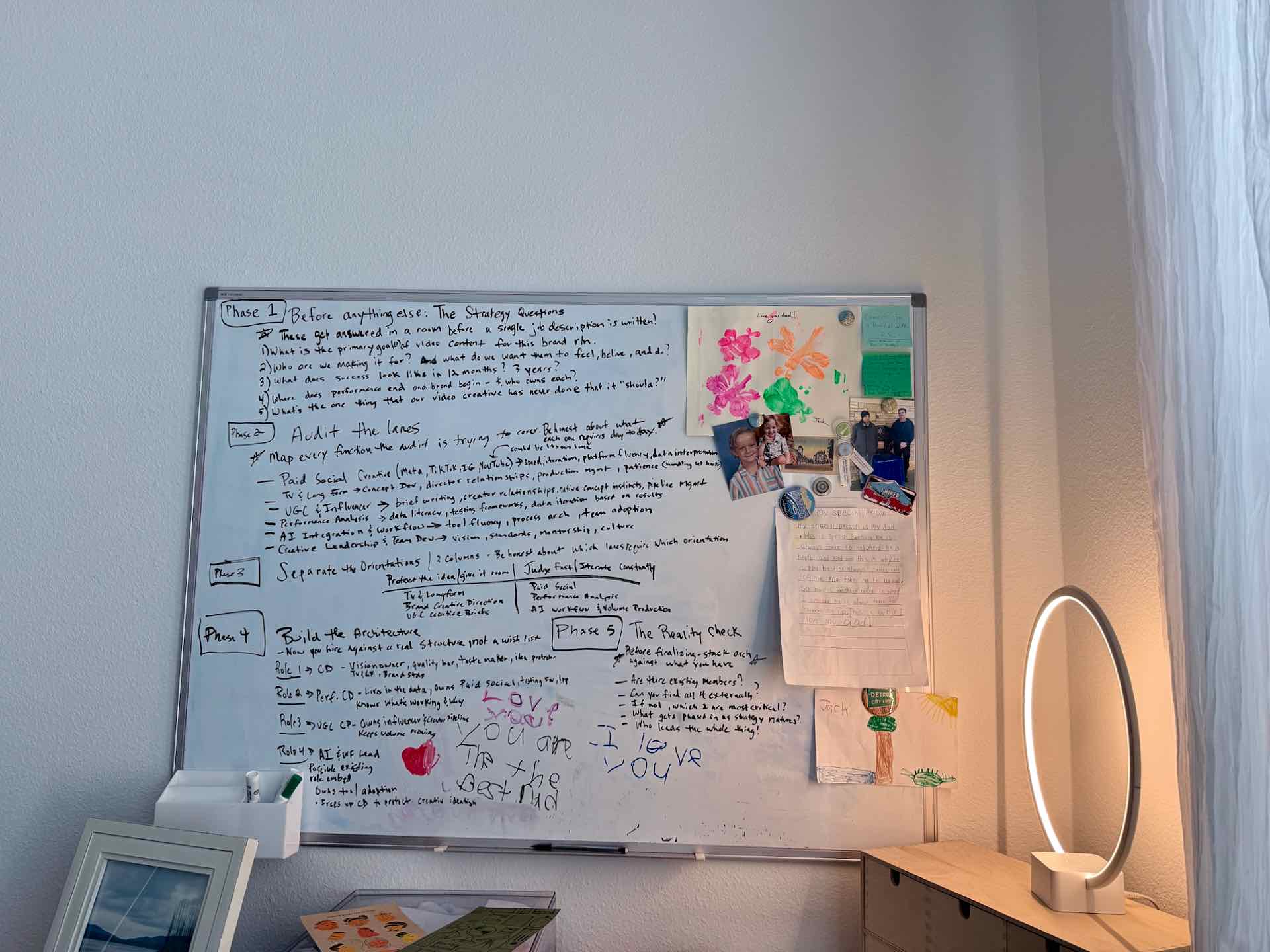
There is a job description circulating right now — you may have seen it, or one exactly like it. You may even be hiring for it. It is looking for a Creative Director who leads breakthrough video creative across paid social and television, develops UGC and influencer frameworks, manages platform performance data across Meta, TikTok, and YouTube, champions AI adoption across a lean team, and still finds time to push into creative territory no one in the category has explored yet.
That last part. Let's stay there for a moment.
The organization wants someone to boldly go where no creative director has gone before — while simultaneously hitting weekly performance targets on four platforms, managing a UGC pipeline, integrating AI into a team's daily workflow, and developing TV concepts with outside production partners. I'm not sure how you plan for that. I'm not sure a plan is possible. The mandate to explore uncharted creative territory and the mandate to perform at the speed of social and television are not two points on the same map. They exist in fundamentally different relationships with time, pressure, and the patience required for an idea to become something worth making.
But someone will get hired for it anyway.
This isn't a critique of the company that wrote it. It's an observation about what job descriptions like this one actually are: a window into an organization that hasn't finished a conversation it needed to have before it started hiring. The brief didn't fail because someone wrote it carelessly. It failed because the strategic question underneath it — what do we actually need, and in what order — was never resolved. So instead of an answer, you get a list. And the list becomes the job description.
A job description is a brief. It should reflect a decision that's already been made, not a set of problems that still need sorting. When it reads like a wish list, it tells you something important: the organization is hoping the right hire will resolve the ambiguity that leadership hasn't. That's a significant amount of pressure to place on a single headcount — and it's unfair in a way that rarely gets named directly.
Consider what's actually being asked of the person who takes this role. They're expected to hold two creative orientations simultaneously that don't naturally coexist. A Creative Director's instinct is to protect ideas from premature judgment — to give a concept enough room to become what it needs to be before the metrics weigh in. Performance marketing's instinct is to judge constantly, kill the losers fast, and let the data lead. Most people who are genuinely good at one have trained themselves, consciously or not, to resist the other. The CD who's spent a career fighting for the integrity of an idea doesn't naturally reach for the dashboard. The performance marketer who's optimized hundreds of ad variants has often sanded off whatever made the work interesting in the first place.
The job description acknowledges this tension directly. They want "the rare CD who thinks in tests." Rare is doing a lot of work in that sentence.
Here's what I think actually happens. Someone takes this job — a real person who reads that description, maps their experience against it, and decides they can hold it together. The hiring manager has the best of intentions. They wrote every line of that description believing it. And in the early weeks there's momentum and goodwill and the reasonable optimism that comes with a new hire in a new role.
Then the realities of the job set in. The content calendar doesn't pause for creative development. The platforms don't care that the brief was ambitious. Meta wants iterations by Thursday. The TV concept needs to go into production before the strategic framework it was supposed to emerge from has been written. The UGC pipeline needs briefs for creators who needed them yesterday. And somewhere in the middle of all of it, the creative director is supposed to be charting new creative territory for a category that's been doing things the same way for a hundred years.
I've seen this movie. The creative falls flat. Not because the person wasn't talented — they almost certainly were — but because the structural conditions of the role didn't leave room for the kind of work the job description was romanticizing. Emotional resonance requires time and space. Effective storytelling requires a point of view that's been protected long enough to develop into something real. When you're moving at the speed of social and TV simultaneously, under performance pressure that was unrealistic from the start, the work becomes competent at best. It hits the deadlines. It fills the placements. It doesn't move anyone.
Eighteen months later, everyone is quietly disappointed and no one is entirely sure why. The creative director knows why. They knew when they read the description. They could feel exactly where the contradictions were. They took the job anyway.
What this company actually needed wasn't a unicorn. It needed someone to come in before the hire — a strategist with enough distance from the internal dynamics to ask the question plainly: what is your video strategy, and what kind of team does that strategy actually require? That conversation, done honestly, produces a team architecture that reflects real priorities rather than accumulated wish list items. It costs less than people assume, and considerably less than the compounding cost of a creative director set up to fail and a video strategy that remains unresolved because the hire was asked to carry a decision that should have been made upstream.
The brief is always the tell. In content, in production, in hiring — what gets written before the work begins reveals everything about whether the work has a real chance. An organization that hasn't decided what it believes will produce a brief that asks for everything. And a brief that asks for everything is, in the end, a brief that has decided nothing.