
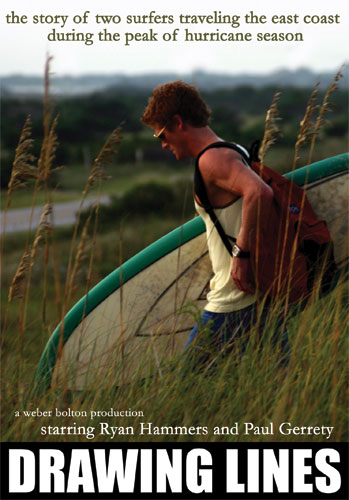
About a third of the way into Drawing Lines there's an evening session at Folly Beach, South Carolina. The next morning there's another one. Clean and offshore, waist to chest high, the first real lines of Hurricane Frances filling in at sunup. Ryan Hammers and Paul Gerrety trade waves in soft light.
If you watched the film when it came out in 2005, that's what you saw. Two guys just out of college, a 1962 Ford Falcon van, and a banner hurricane season up the East Coast.
Here is what happened between those two sessions.
The Lot
We had parked in an empty dirt lot behind a gas station, because there's almost no public parking on Folly Beach, and because we weren't in the van. We were in a Class C RV we called the Smeller-B, because it had a strange smell and we'd bought it from a guy named Ellerby. The van rode behind it on a dolly. The RV never appears in the film. Neither does the drive shaft we had to disconnect every time we loaded the van onto the dolly, and reconnect every time we took it off, so the Falcon could roll into frame looking like the only vehicle on the trip.
That night it was unbelievably hot. Ryan and I went to bed early and ran the generator for the AC. Josh Bolton, my filmmaking partner, came back from the bar with Paul and shut it off. It was loud, he didn't want us drawing attention, and it needed an oil change. Fair on all three counts.
I slept fine. Ryan did not. He paced the length of the RV until he decided the answer was airflow. He rolled down the windows, got in the driver's seat, and started driving north up the island's one narrow two-lane road.
"Hey, don't forget about your buddy on the roof!"
Josh was asleep in the bunk over the cab. He woke up to find us moving and asked Ryan, "What are you, some kind of baby that needs cold air blown on your ass at night so you can sleep?" Ryan didn't have a great answer. Then we ran out of road.
Ryan couldn't turn a Class C around with a van on a dolly behind it. Josh climbed down and did it himself in about eighteen points, drove us back to the lot, and told Ryan to go sleep on the roof. Ryan took his pillow and blanket and went.
Sometime later there was knocking, then a flashlight through the window. Paul laughed and stayed put. The beam found me on the bed we made each night by dropping the dining table and laying the cushions over it.
"Hey, I can see you, boy."
So I got up. We couldn't park there. I got in the driver's seat, started the engine, and was about to pull out when the officer yelled after me: "Hey, don't forget about your buddy on the roof!"
I stopped. Ryan climbed down. We slept the rest of the night in a Walmart parking lot near Charleston, and at sunup we were back in the water at Folly, filming the session that's in the movie.
Later that day we decided we were done with the dolly, and we laughed about the night most of the way up the road. Josh drove the van for most of the rest of the trip. Paul and I drove the RV. Ryan never drove it again. The dolly stayed behind in New Jersey, at a fill station owned by the dad of my friend Tony Iannarone, who shapes boards under the name Clean Ocean.
The Smeller-B took its share of punishment. We ripped the carpet out in Rhode Island and painted the floors. A tropical storm took the door off on Long Island, and we bungeed it shut from there to Maine and all the way home. We had the door replaced before we sold it, for more than we paid, to some guys who needed a place to stay in Jacksonville for the Super Bowl.
We Had No Idea
None of us knew how to make a feature film. Josh and I did know how to run digital cameras and cut footage. We met at Video Law Services, where he was a motion graphics artist and editor and I was a paid intern in college. It became my first job out of school.
One day the owner told me she was going to fire Josh. I knew he was already planning to quit. Around the same time, he asked me what I really wanted to do, and I said I wanted to make a surf film. So I told him not to quit. Wait, let them fire you, take the severance. He waited.
We cut a three-minute sizzle reel to show investors, and with it we raised enough money to buy camera gear and an RV, make the film, and live for two years without jobs. That stretched further than it should have. Gas was $1.59 a gallon, and tuna fish was a staple food. I rented a room from a surf buddy for $200 a month. Josh had a $500 studio on a property owned by a session musician in Jacksonville Beach, and that studio was our edit suite.
I knew Paul from high school and Ryan from a photography class in college. The plan, such as it was, was to surf every state on the Atlantic coast, from the sandy beaches of Florida to the cold, rocky coast of Maine, during the 2004 hurricane season, and come home with a movie.
It worked better than it had any right to. Eastern Surf compared Paul's carves on fish and single fins to Wingnut and Ryan's airs to Pat O'Connell. Transworld told readers to add it to their collections. The Cucalorus Film Festival wrote it up kindly. We won the Audience award at the Atlanta Underground Film Festival. The DVD is still on Amazon for $7.09 and you can find it’s streaming on the Surf Network.
What we didn't know how to do showed up mostly where the camera wasn't. Josh was the oldest of us, and the three younger guys were not easy company. We pushed his buttons because we could, and because we didn't yet know how not to. He didn't always make it easy either. Most of what that summer felt like, the heat and the arguments and the eighteen-point turns and the laughing the next afternoon, lives in the gap between sessions.
The Garden Hose
Drawing Lines opens on the van in a downpour. It's night. Paul and Ryan climb into the Falcon, the doors close, the engine turns over, and they drive off. Nobody says a word. Just rain.
Later in the film we play the scene again, and this time they talk. It's the only on-camera dialogue Ryan and Paul have in the whole movie. Ryan says the bridges are closing in fifteen minutes. Paul says, "I know, we've got to get out of town." The story is that Hurricane Ivan is bearing down on the Gulf Coast, the boys evacuate, and the next morning they're surfing Virginia Beach.
Here's what actually happened. We were in the Outer Banks, the waves were terrible, and Ivan had just moved into the Gulf of Mexico. We knew the Gulf Coast would have a short window of really good surf before it turned dangerous. So we left the van in long-term parking at the Raleigh airport and drove all night to Pensacola Beach. Alabama and the Gulf were never part of the plan. Ivan added them, thanks but no thanks. We surfed Alabama Point, filmed the Pensacola sessions, and when Ivan turned toward us, we stayed.
We parked the RV in an open lot, away from anything that could fall on it or fly into it, and pointed it west. If the wind was going to hit it broadside, we wanted that to happen from the north or south, where we figured the gusts would be weaker. Then we rode out the storm at Julian and Kim MacQueen's house. The MacQueens were at their place on Salt Spring Island in British Columbia, so it was us, Julian's nephew John Rocket, and Harlan Butler, a VP at Julian's hotel company.
The night Ivan made landfall, the windows bowed inward. We spent it laying towels under the ones that leaked and waiting for the glass to go. It held. In the morning we dragged downed limbs and trees out of the yard and helped a neighbor with a chainsaw clear a fallen tree off the road. Then we went to check on the RV. There was debris everywhere around it and not a scratch on it.
I had installed a water filter in the RV, one my dad had given me. Before we left, we ran the pool water through it and filled as many gallons as we could for John and Harlan. We checked on Paul's parents, who were fine apart from the downed trees. Pensacola Beach was not fine. Ivan destroyed more than half the homes on the island. Across the sound at the Gulf Islands National Seashore in Gulf Breeze, debris from those homes had washed up in piles ten feet high and fifteen feet wide along the shoreline.
Then we drove back to Raleigh, picked up the van, and went to Virginia Beach. That part made the film.
The evacuation was shot that November, after the trip was over, in front of Paul's parents' house in Gulf Breeze, the same house we'd checked on the morning after the storm. Paul's dad stood out of frame with a garden hose aimed at the windshield. At night, on tape, the rain looks completely real. The dialogue sounds exactly like two surfers reading lines.
The Gulf Coast stretch had its own casting. At Alabama Point we surfed with Graham Wade, who ripped and was all of fourteen, so we needed his parents' permission. An older surf friend of mine who had put money into the film recommended him. Graham later flew up to Newark to join us for New Jersey and Long Island, and one of Tony's New Jersey friends stood in as his uncle, so Graham could make a clean entrance into the story.
Behind the Camera
Josh and I weren't in the film at all. That was his call. I surf too, and I thought putting us in would help the story: all four of us on the trip, the filmmakers part of the thing being filmed. He disagreed, and he limited how much I surfed. There's a session I sat out on the beach behind a camera until the waves fell apart. Then Josh told me to go have a surf.
To be fair to him, keeping the filmmakers invisible is the oldest convention in surf movies, and two everyman surfers on a quest is a clean story. I agreed to it. I've regretted agreeing to it for twenty years.
Ryan and Paul knew how much it bothered me, and they pushed for me to get in the water more. One morning in North Carolina, I did.
Long Beach faces south, so the north wind was offshore. Clear sky, mid-morning, Frances swell. I was riding a blue, acid-splashed 9'6" Clean Ocean Custom shaped by Tony, and on the west side of the pier I got some of the best nose rides of my life. Ryan, who has a photography degree and a good eye for surfing, filmed it. We could have made the film with all four of us in it. We had the crew.
I pulled a still from that footage and printed it. Me hanging five, goofy-foot and frontside on a long, clean, chest-high left, the light bright and flat across the water. I can't find the print. The tapes, if they still exist, are with Josh, and Josh and I haven't spoken in a long time.
The Score
We shot about 250 hours of footage. Getting it into the edit meant playing every tape back in real time, second for second, while the computer captured it. Today that's a click. At least it was already digital, so nobody had to convert anything.
Every note of music in the film is original, and almost all of it was a gift. Josh had played in a band called Juice back in Maryland and still kept in touch with the musicians there. One of them, Paul Hutzler, offered to score as much of the film as he and his friends could. We sent him scenes, and he sent back music.
We did try for a couple of songs we couldn't afford. Herbie Hancock's people wanted $1,500 just to pay their lawyers to come up with a price. We passed. Leo Kottke said no too, but he did it in a handwritten letter. He had written "Owls" for his grandmother and never saw it being used commercially. We respected that. We'd already cut a version of the ending to "Owls," and it was beautiful.
The opening song shares the film's title. Our friend Drew Bishop wrote it and played it live at the premiere. A year later he died in a car accident. His voice and his guitar are the first thing you hear in Drawing Lines, and they always will be.
The Ledger
When we got home, we sold the camera gear to buy an editing computer and more tuna fish.
When the film was done, Josh and I took it on the road ourselves. We premiered it privately for friends and family at the IMAX theater in the National Naval Aviation Museum in Pensacola, then booked theaters in Jacksonville Beach, Wilmington, and Ellicott City, Maryland, and came back to Pensacola for a public showing. Josh designed flyers, and we put them up in every town we played. Before they went out, we showed them to Julian and Harlan. Harlan pointed out that the font made Lines look like Guns. It did. Fixing a graphic back then was not a one-minute job. Hundreds of people saw it on that tour, maybe thousands.
We signed with a surf film distributor, and the DVD ended up in surf shops all over the country. The film never broke even. Our investors lost their money, and later told us they didn't care. They liked what we made and had never really expected to see it come back.
It was the best time of my life before my kids, and I made it with no money and no idea what I was doing. I know how to make films now, mostly short documentaries.
When I watch Drawing Lines today, I see what everyone sees: an hour of clean East Coast surf and two friends having the summer of their lives. I also know exactly what I was doing in every scene, where I was standing, and whether I got to surf that day.
I'm ready to make another feature. This time I might have to put myself in it to get it done.