There's a section of the Appalachian Trail near Springer Mountain in Georgia where the terrain changes quickly. The grade steepens, the roots get technical, and you stop thinking about anything except where your feet are going next. I've been up that hill more times than I can count now. The first time I was working. One of the most recent times, I was hiding behind a boulder with my five-year-old son, waiting to surprise a friend a hundred yards from the finish of a speed record.
Those two experiences are separated by about a decade, a documentary film, four return trips to the trail, and everything that changes in a person when they stop being someone who documents life and start being someone who lives it in a way that makes them want to document it differently.
I worked as a producer on Made to be Broken, the 2016 Red Bull documentary that followed Karl Meltzer's successful Appalachian Trail speed record attempt. Red Bull deserves real credit for what they've built — they are arguably one of the greatest content marketing brands in history, and they've given an enormous number of creative people the opportunity to hone their craft in conditions most brands would never greenlight. The AT film was one of those opportunities. My job was largely behind the camera and off it entirely — managing the field crew, handling budgets, working with our permitting contractor to secure everything we needed to film on federal and state land along the full length of the trail. That work is unglamorous and essential. It's the part of documentary production that never appears in the behind-the-scenes footage because it happens before the cameras are even unpacked.
The film was okay. I mean that in the most honest sense — it accomplished what it set out to accomplish. It documented a record. It captured the terrain and the human cost of 2,190 miles in 45 days. But okay is not the same as great, and I knew the difference even then.
Great films have a quality that's difficult to name and impossible to manufacture. They make you feel like you were there — not as a spectator, but as a witness to something true. They get watched thirty years later by people who weren't alive when the thing they're watching happened. They earn that. And earning it requires something that resources alone cannot buy: the sustained, patient, intentional attention of someone who understands what they're looking at — and keeps coming back until they do.
I've been back to the AT four times since Made to be Broken. Each trip has shown me something the previous one couldn't have. The trail is the same. I'm not.
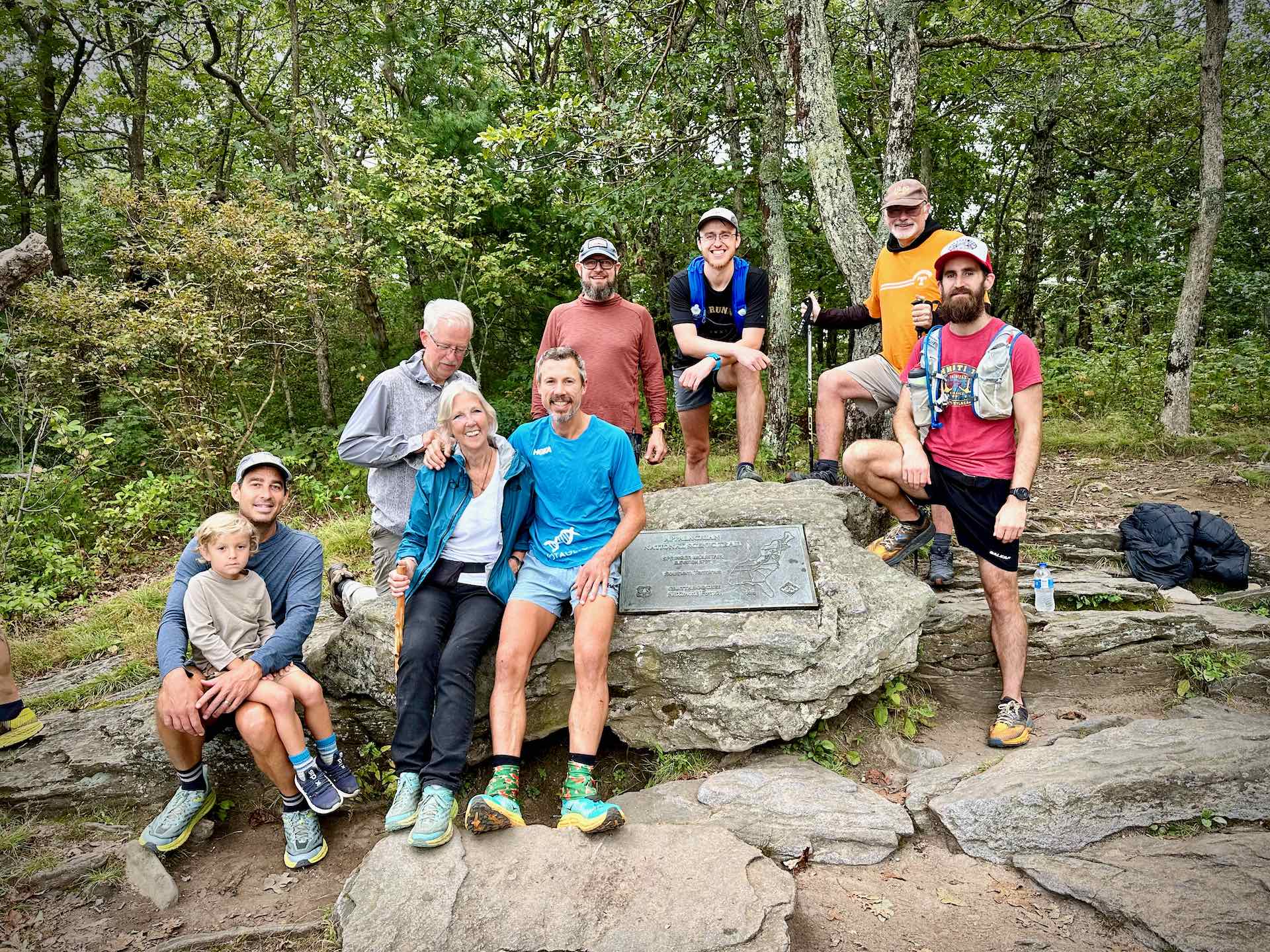
Those return trips weren't random. Since February 2020 I've been in regular contact with ultrarunner Kristian Morgan — communicating via Skype and WhatsApp, following his training, his attempts, his thinking about the trail. In 2022 I met him in person for the first time on the AT in New Jersey and ran sections with him over two days while he was going after the northbound record. He finished that attempt in 44 days — the second fastest completion of the AT at the time. That same year, Kristian and his mother Sharon came out to Utah when I ran the Speedgoat 50K. They were waiting at the Hidden Peak aid station, handing me water and grabbing food while I tried to keep moving.
There's a documentary series I've been developing about the AT — the full story of the trail, the thru-hikers, the people who have chased records and broken them. Made to be Broken barely scratched the surface, and I've been thinking about what the real version of that story looks like ever since. Life intervened. A family. Resources. Logistics. The overall record has been broken three times since 2016. I'm not ready to make it yet. Some films take ten or fifteen years to find their moment — and I've come to believe that's not a failure of momentum. It's the work of understanding what you're actually looking at.
In 2023 I drove up to Cherry Log, Georgia with my son Jack — just the two of us. He was five. By that point he'd already hiked with me in Slovakia, Utah, Wyoming, Montana and Florida, sometimes on his own feet and sometimes in the Osprey pack on my back. We arrived the night before Kristian was set to finish his southbound AT speed record attempt. The next morning Jack and I hiked up Springer Mountain with Sharon, not knowing exactly when Kristian would arrive or whether we'd be there when he did.
We were. And when we heard him coming up the trail, the three of us ducked behind a boulder about a hundred yards from the summit and waited.
Kristian Morgan finished a speed record on the Appalachian Trail and found his mother, a five-year-old, and an old friend hiding in the rocks waiting for him. That's not something you can write into a shot list. That's what happens when you show up before you know what you're going to find.
That evening the four of us had dinner together — Kristian, Sharon, Jack, and me. The next morning, before we drove home, Jack and I ran up the hill together by the cabin. Halfway up he reached for my hand. I took it.
At some point during the hike up Springer I had pulled out my phone and interviewed Jack on the trail, the way you do when a moment feels too large to just watch. I asked him what we were doing up there.
"We're at the Springer Mountain hiking to go see Kristian," he said. "He's running on the Appalachian Trail." Then he looked past the camera. "Is that another white blaze there?"
He already knew what a white blaze was. He already understood that someone was out there running the trail. And he was already looking for the next one — not because anyone told him to, but because he'd been paying attention.
I didn't have children when I worked on Made to be Broken. That matters more than it might sound. The AT means something completely different to me now — not as a production location or a record venue, but as a place I share with my kids. Last summer Jack ran technical trails in New Hampshire on his own, including a section going up from Pinkham Notch on the AT. I carried his younger brother Max in the Osprey, but even Max wanted out of the pack to walk on his own. The trail is in them now. I don't know what to do with that except keep showing up and see what it becomes.
Kristian is going back this summer for a self-supported FKT attempt on the AT — no crew, no pacers, carrying everything himself. A fundamentally different undertaking than the supported record we witnessed in 2023. The story isn't finished. It never really is.
Which is the point.
The story you can tell after two weeks with something is different from the story you can tell after ten years of caring about it. The first version captures what happened. The second version captures what it meant. The gap between those two things is where great work lives — and it cannot be closed with budget or resources or the right equipment. It can only be closed with time, intention, and the willingness to keep returning until you understand what you're actually looking at.
That's what we bring to every engagement at Can & String. Not just the craft to make something technically accomplished. The patience to find out what the story actually is. The discipline to come back until we do.
The AT taught me that. Jack looking past my camera for the next white blaze reminded me why it matters.